
When people talk about fast fashion, names like Zara, H&M, and Shein usually dominate the conversation. But Uniqlo often sits in a gray area—popular, affordable, and global, yet seemingly more restrained in style and messaging. This raises a common and important question: Is Uniqlo fast fashion, and if so, how is it different from other global brands?
To answer this honestly, we need to look beyond price tags and trends and examine Uniqlo’s business model, production cycle, sustainability claims, and long-term brand philosophy.
What Defines Fast Fashion in the First Place?
Before asking is uniqlo fast fashion, it’s essential to define what fast fashion actually means. Traditionally, fast fashion brands are characterized by:
-
Rapid trend replication from runways to stores
-
Short product life cycles
-
High-volume, low-cost production
-
Frequent inventory turnover
-
Heavy reliance on impulse buying
Brands like Zara and Shein are built around speed—designing, manufacturing, and delivering new styles in weeks or even days.
Uniqlo’s Business Model: Speed vs. Stability
So, is Uniqlo fast fashion in the same way as its competitors? Technically, Uniqlo does fall under the fast fashion umbrella because it produces clothing at scale and sells it at affordable prices. However, the way it operates is noticeably different.
Unlike trend-driven brands, Uniqlo focuses on:
-
Timeless basics instead of seasonal fashion
-
Functional design (HeatTech, AIRism, Ultra Light Down)
-
Longer product cycles, with items staying in stores for years
-
Minimal style variation, prioritizing quality and usability
This approach reduces the constant pressure to push new trends, which already separates Uniqlo from typical fast fashion brands.
Design Philosophy: Fashion vs. Function
One of the strongest arguments in the debate around is uniqlo fast fashion is its design philosophy. While most fast fashion brands chase trends, Uniqlo invests heavily in textile innovation and functionality.
Examples include:
-
Heat-retaining fabrics for winter
-
Breathable, moisture-wicking materials for summer
-
Clothing designed for daily wear, not social media trends
This means Uniqlo shoppers are more likely to keep items longer, reducing disposable fashion behavior—something rarely associated with classic fast fashion.
Production Speed and Inventory Turnover
Production speed is another key factor when analyzing is uniqlo fast fashion. Uniqlo operates on a planned production model rather than reactive trend chasing.
-
Products are developed months or years in advance
-
Restocking is based on data, not hype
-
Best-selling items are refined, not replaced
In contrast, brands like Zara intentionally create scarcity and rapid turnover, encouraging frequent purchases. Uniqlo’s model favors consistency over urgency.
Sustainability and Ethical Practices
Sustainability plays a major role in answering whether is uniqlo fast fashion in the traditional sense.
Uniqlo has made measurable efforts in:
-
Recycling programs for used clothing
-
Reducing water consumption in denim production
-
Partnering with ethical manufacturing initiatives
-
Publishing supplier transparency reports
While Uniqlo is not a slow fashion brand, it has taken more concrete steps toward responsibility than many global fast fashion competitors.
That said, critics still point out that large-scale production inherently carries environmental costs—so Uniqlo is better, not perfect.
Price Point and Consumer Behavior
Affordability often triggers the fast fashion label. Yes, Uniqlo is affordable—but affordability alone doesn’t fully answer is uniqlo fast fashion.
The key difference lies in how consumers use the clothing:
-
Uniqlo items are designed for repeated, long-term use
-
Basics encourage wardrobe stability rather than constant replacement
-
Fewer seasonal “must-have” items reduce impulse buying
This subtly shifts consumer behavior away from excessive consumption.
Comparison with Other Global Brands
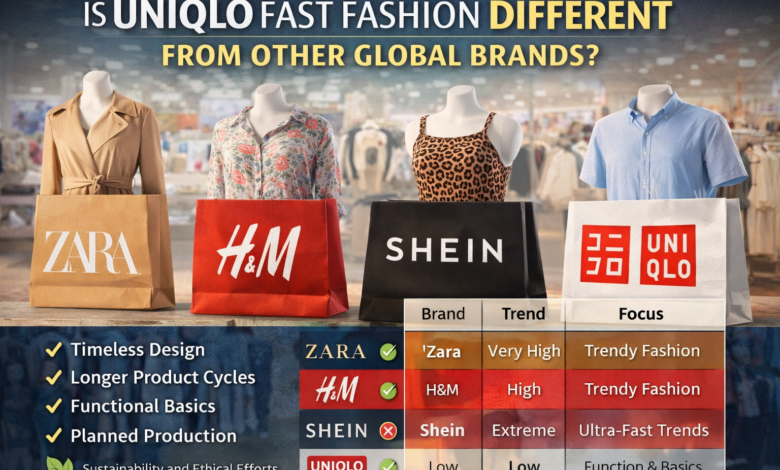
| Brand | Trend Speed | Product Lifespan | Focus |
|---|---|---|---|
| Zara | Very High | Short | Trend replication |
| H&M | High | Short to Medium | Fashion variety |
| Shein | Extreme | Very Short | Ultra-fast trends |
| Uniqlo | Low | Long | Function & basics |
This comparison shows that while Uniqlo operates at scale, its philosophy and execution clearly differ.
Final Verdict: Is Uniqlo Fast Fashion?
So, is Uniqlo fast fashion?
Yes—by industry definition.
But no—by behavior, design intent, and product longevity.
Uniqlo sits between fast fashion and slow fashion, offering a hybrid model that emphasizes:
-
Durability over disposability
-
Function over trend obsession
-
Planning over reaction
For consumers seeking affordable clothing with fewer ethical and environmental trade-offs, Uniqlo represents a more responsible alternative within the fast fashion space.